The Organ of the Lucjan Lipiński Hall at the SOKÓŁ Małopolska Culture Centre

The idea of building an organ in the multifunctional hall of the SOKÓŁ Małopolska Culture Centre in Nowy Sącz originated with Antoni Malczak, director of SOKÓŁ MCC from 1985 to 2019.
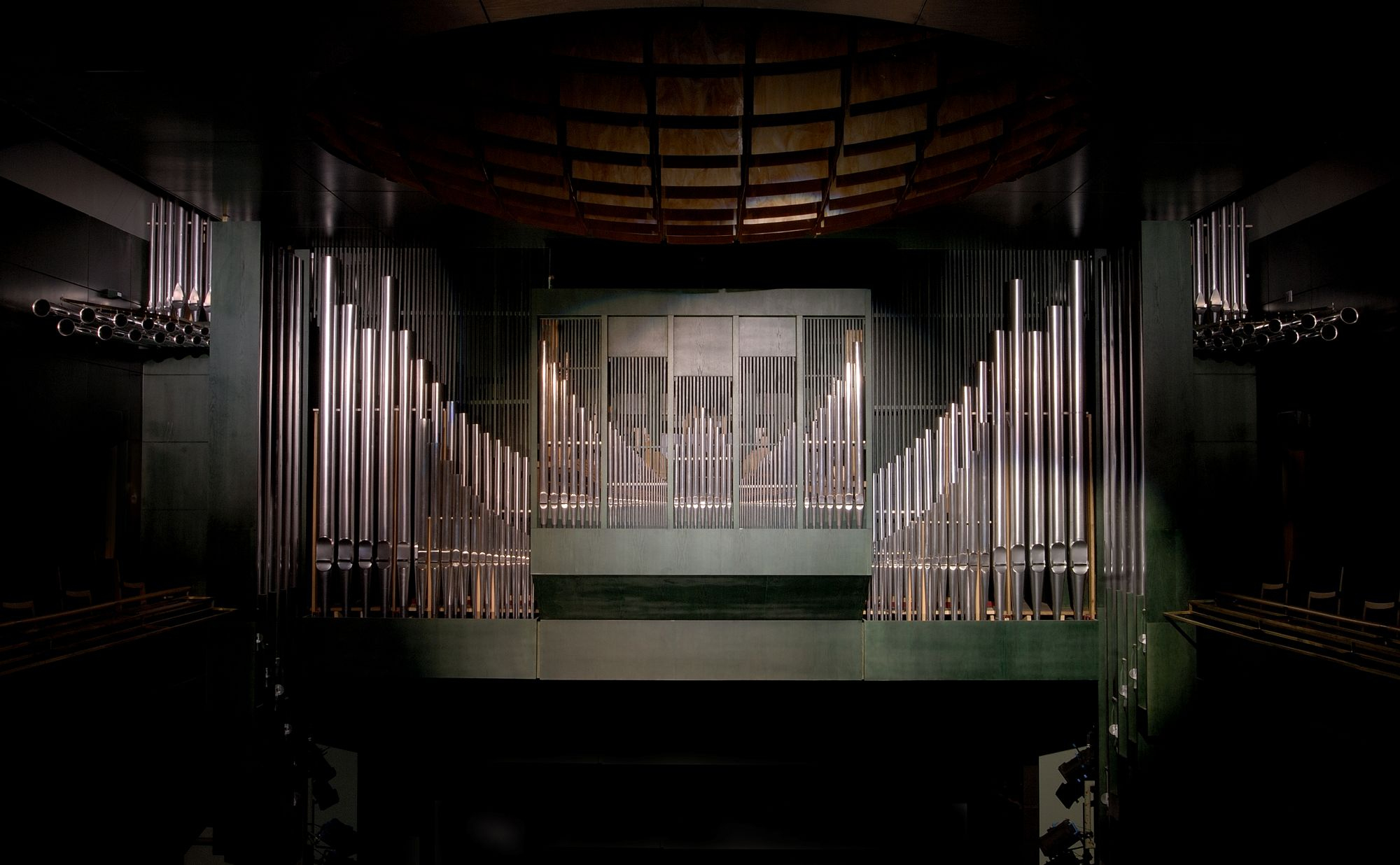
Since high costs made building a brand-new organ impossible, the decision was made in 2005 to purchase a used instrument from the Walcker company in Ludwigsburg. This organ was originally installed in St. Luke's Church in Lampertheim, Germany. Many of its original components were reused, including the windchests, console, and pipes. The tonal concept was developed by Ireneusz Wyrwa, the organ case was designed by Marek Kozień, and the installation was carried out by the IN PLENUM PL company with the assistance of Mieczysław Klonowski. The instrument was inaugurated in 2007.
The challenging acoustics of the hall necessitated further modifications and improvements to the installed instrument. In 2016, the Pécsi Orgonaépítő Manufaktúr company modernized the organ. An electric key action was introduced, and the console was moved to a side balcony and placed on a rotating platform. Removing the mechanical action allowed for a more acoustically favorable arrangement of the pipework. The winding system was improved, the bellows were replaced, and some stops—including the reeds—were exchanged. A new electronic system allows, among other things, for the Trompette en chamade to be assigned to any division and for the recording and playback of performances. The process concluded with a complete re-voicing of the instrument.
Today, the organ at SOKÓŁ MCC is a modern instrument with extensive tonal and dynamic capabilities, while still preserving many historical elements. The SOKÓŁ Małopolska Culture Centre in Nowy Sącz is likely the only place in Poland where a cinema coexists with a full-fledged pipe organ as a permanent fixture of the hall.
The instrument features 54 stops (51 real pipe ranks), three manuals and a pedalboard, with electric key and stop action.
Manual compass: C–g3; pedal compass: C–f1.
|
Manual I (C–g3) |
Manual II (C–g3) |
Manual III (C–g3) |
Pedal (C–f1) |
|
Great |
Positiv |
Swell box |
|
|
1. Principal 16' |
1. Gedackt 8' |
1. Bourdon 16' |
1. Untersatz 32' |
|
2. Principal 8' |
2. Praestant 4' |
2. Diapason 8' |
2. Principalbaß 16' |
|
3. Rohrflöte 8' |
3. Rohrflöte 4' |
3. Cor de nuit 8' |
3. Subbaß 16' |
|
4. Flûte harmonique 8' |
4. Quinte 2 2/3' |
4. Gambe 8' |
4. Violonbaß 16' |
|
5. Gemshorn 8' |
5. Blockflöte 2' |
5. Voix céleste 8' |
5. Octavbaß 8' |
|
6. Octave 4' |
6. Terz 1 3/5' |
6. Viole 4' |
6. Gedacktbaß 8' |
|
7. Nachthorn 4' |
7. Larigot 1 1/3' |
7. Flûte octaviante 4' |
7. Cello 8' |
|
8. Quinte 2 2/3' |
8. Scharff 3f 1' |
8. Nasard 2 2/3' |
8. Octave 4' |
|
9. Octave 2' |
9. Krummhorn 8' |
9. Octavin 2' |
9. Bombarde 16' |
|
10. Cornett 5f (od g) |
10. Trompette en chamade 8' |
10. Tierce 1 3/5' |
10. Posaune 16' |
|
11. Mixtur 5f 1 1/3' |
|
11. Mixtur 4-6f 2 2/3' |
11. Trompete 8' |
|
12. Trompete 16' |
|
12. Basson 16' |
12. Trompette en chamade 8' |
|
13. Trompete 8' |
|
13. Trompette harmonique 8' |
|
|
14. Klarine 4' |
|
14. Hautbois 8' |
|
|
15. Trompette en chamade 8' |
|
15. Voix humaine 8' |
|
|
|
|
16. Clairon harmonique 4' |
|
|
|
|
17. Trompette en chamade 8' |
|
|
Couplers : P/I, II/I, III/I, Sub III/I, Super III/I, III/II, Sub III/II, Super III/II, Sub III, Super III, I/P, II/P, III/P, Super III P |
|||
The Organ of St. Casimir’s Church
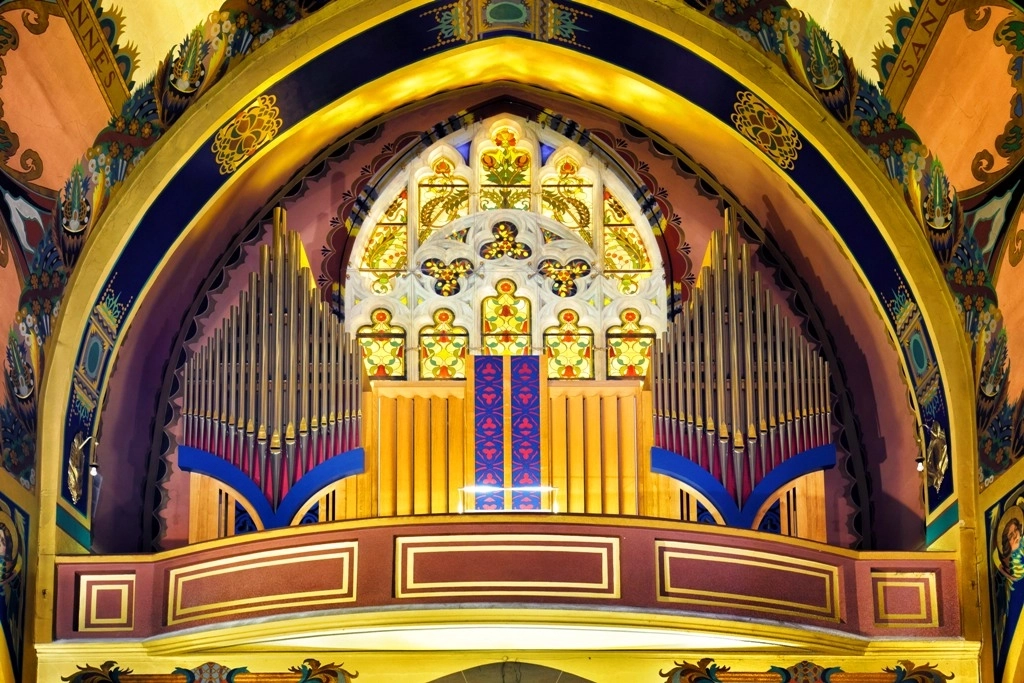
The construction of the new organ at St. Casimir’s Church was initiated by Rev. Jan Siedlarz to commemorate the upcoming centenary of the parish. The development of the concept was entrusted to Ireneusz Wyrwa. After evaluating proposals from four renowned companies from Germany, Austria, and Switzerland, the offer from the Werkstätte für Orgelbau Mühleisen from Leonberg near Stuttgart was selected. Led by Konrad Mühleisen (a protégé of the Weigle company), the workshop has been operating since 1986.
The instrument was designed in the spirit of the early Romantic organ-building tradition, with a particular emphasis on the tonal aesthetics of Eberhard Friedrich Walcker. Among its unique stops are the Physharmonica (housed in a separate division, featuring reeds similar to a harmonium and a Windschweller – a foot lever that regulates air pressure and volume) and the Harmonika (a narrow-scaled, open wooden stop with slightly slanted rear walls).
Construction began in 2014 with the dismantling of the old instrument. In 2015, the assembly and voicing of the new organ took place. The ceremonial inauguration was held on January 30, 2016. The instrument was blessed by Bishop Stanisław Salaterski, and the inaugural concert was performed by Ireneusz Wyrwa.
The organ features slider chests and a dual stop action (mechanical and electric). The detached console is positioned to allow the organist to play with their back to the chancel.
The instrument has 30 stops, three manuals and a pedalboard, mechanical key action, and mixed stop action. Manual compass: C–c4; pedal compass: C–g1.
|
Manual I (C–c4) |
Manual II (C–c4) |
Manual III (C–c4) |
Pedal (C–g1) |
|
1. Bourdon 16' |
1. Principal 8' |
1. Physharmonica 8' |
1. SubBass 16' |
|
2. Principal 8' |
2. Lieblich Gedekt 8' |
|
2. ViolonBass 16' |
|
3. Floete 8' |
3. Salicional 8' |
|
3. OctavBass 8' |
|
4. Gedekt 8' |
4. Harmonika 8' |
|
4. Violoncell Bass 8' |
|
5. Viola da Gamba 8' |
5. Fugara 4' |
|
5. FloetenBass 4' |
|
6. Octav 4' |
6. Flûte d‘amour 4' |
|
6. Posaunen Bass 16' |
|
7. Rohrfloete 4' |
7. Nasard 2 2/3' |
|
7. Trompeten Bass 8' |
|
8. Traversfloete 4' |
8. Flautino 2' |
|
|
|
9. Quint 2 2/3' |
9. Terz 1 3/5' |
|
|
|
10. Octav 2' |
10. Clarinette 8' |
|
|
|
11. Mixtur 5 fach 2' |
|
|
|
|
12. Trompete 8' |
|
|
|
|
Couplers: II/I, III/I, III/II, II/II 16', II/II 4', I/Ped, II/Ped, III/Ped, III/Ped 4' |
|||
The Organ of the Church of the Holy Spirit

The organ in the Church of the Holy Spirit in Nowy Sącz was built in 1933 by the Rieger company (Opus 2582). The instrument originally featured pneumatic action and an electric blower (with the motor housed in a separate room next to the choir loft). The console was positioned centrally in front of the organ case, with the organist facing the altar. The windchests of Manual II were equipped with an additional octave for the super-octave coupler. Installation was completed in June, and the ceremonial inauguration took place in July 1933, featuring Bronisław Wallek-Wallewski accompanying the singer Ada Sari.
In the 1960s, the instrument was rebuilt by the Biernacki company. The action was converted to electro-pneumatic, and the console was replaced (extending the manual compass to a³). A bellows for Manual II, a tremolo device, and two stops—Flutebas and Sesquialtera—were added. The cone valves in the windchests were likely also replaced at this time.
Another renovation was carried out in 1984 by Tadeusz Rajkowski; the instrument was cleaned, the pouches were replaced, and the bellows and action power supply were repaired. Due to its deteriorating technical condition, a general overhaul was performed in 2023 by the Organmistrzostwo Mateusz Jabłoński workshop. During these works, the non-original stops (Quint 2 2/3' and Octave 2') were retained and re-voiced, and an Oboe 8' stop was added. A reconstruction of the original console (along with a return to pneumatic action) was considered but ultimately abandoned for economic reasons.
The organ case is Neo-Gothic, and the instrument utilizes cone-valve windchests. The current detached console is positioned to allow the organist to play at an angle to the chancel.
The instrument has 19 stops (16 real pipe ranks), two manuals and a pedalboard, and electro-pneumatic key and stop action.
Manual compass: C–a³; pedal compass: C–f¹.
|
Manual I |
Manual II |
Pedal |
|
1. Principal 8’ |
1. Violin Principal 8’ |
1. Subbas 16’ |
|
2. Bourdon 8’ |
2. Flute 8’ |
2. Flutebas 8’ |
|
3. Salicet 8’ |
3. Gamba 8’ |
3. Cello 8’ |
|
4. Octave 4’ |
4. Gemshorn 4’ |
4. Oboe 8’ |
|
5. Flute 4’ |
5. Quint 2 2/3’ |
5. Oboe 4’ |
|
6. Mixtura 4x |
6. Octave 2’ |
|
|
|
7. Oboe 8’ |
|
|
|
8. Oboe 4’ |
|
|
Couplers: I/P, II/P, II/I, Super I, Sub I, Super II/I, Sub II/I, Super II, Sub II |
||